Alpha-Numeric
When Solid State electronics made mechanical Score Reels obsolete in the late 1970s, the first generation of digital displays were simple Seven-Segment LEDs — capable of showing numbers and a handful of blocky letters, glowing amber or red against the darkened backbox. By the early 1980s, manufacturers had moved to Sixteen-Segment displays that could render the full alphabet with reasonable clarity. For the first time, a pinball machine could speak.
Bally and Williams used alphanumeric displays extensively throughout the 1980s and into 1991, when Plasma displays took over. Machines could now show player names, shout encouragement — GREAT SHOT, SUPER BONUS — and display the high-score initials that motivated players to put in one more quarter. Speech synthesis chips arrived around the same time, and the combination of spoken words and readable text gave machines a personality that score reels never could.
The characteristic amber glow of a Sixteen-Segment display became the visual signature of an entire era: High Speed, Earthshaker, Cyclone, Taxi, Bride of Pinbot. The displays were capable of simple animations — scrolling text, flashing patterns — and designers used every available trick to suggest life within those glowing segments. When Williams introduced the first Plasma display in 1991, the alphanumeric era ended almost immediately, but those segmented readouts remain instantly recognizable to anyone who spent time in an arcade during the 1980s.
Games (540)
Ned Kelly
Vector Pinball, 2026
Blues Brothers
Homepin, 2025
Lost in Space
Vector Pinball, 2025
Peter Brock / Holden
Vector Pinball, 2025
Eight Ball Fury
Vector Pinball, 2024
Fathom (Mermaid)
Haggis Pinball, 2022
Super Panic Ball
Bandai Namco, 2019
The Flip Side
American Girl, 2019
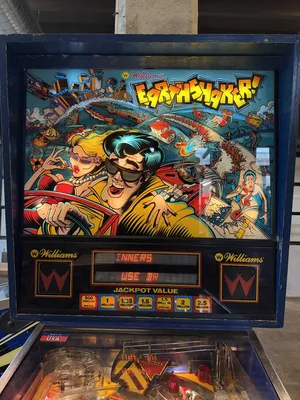
Earthshaker
Williams, 1989
Transformers The Pin
Stern, 2012
Vacation America
Chicago Gaming, 2003
Dona Elvira 2
SLEIC, 1996
Punchy the Clown
Alvin G., 1993
250 cc
INDER, 1992
A.G. Soccer-Ball / A.G. Football
Alvin G., 1991
High Speed
Williams, 1986
Metal Man
INDER, 1992
Operation: Thunder
Gottlieb, 1992
Atleta
INDER, 1991
Bone Busters Inc.
Gottlieb, 1989
Bride of Pinbot
Williams, 1991
Bugs Bunny's Birthday Ball
Bally, 1991
Cactus Jack's
Gottlieb, 1991
Car Hop
Gottlieb, 1991
Class of 1812
Gottlieb, 1991
Harley Davidson
Bally, 1991
Hoops
Gottlieb, 1991
Surf 'n Safari
Gottlieb, 1991
Back to the Future
Data East, 1990
Deadly Weapon
Gottlieb, 1990
Diner
Williams, 1990
Dr. Dude And His Excellent Ray
Bally, 1990
Funhouse
Williams, 1990
King Kong
Data East, 1990
Mundial 90
INDER, 1990
Pool Sharks
Bally, 1990
Radical!
Bally, 1990
Riverboat Gambler
Williams, 1990
Rollergames
Williams, 1990
Silver Slugger
Gottlieb, 1990
The Bally Game Show
Bally, 1990
The Phantom of the Opera
Data East, 1990
The Simpsons
Data East, 1990
Title Fight
Gottlieb, 1990
Vegas
Gottlieb, 1990
Whirlwind
Williams, 1990
Atlantis
Bally, 1989
Bad Cats
Williams, 1989
Big House
Gottlieb, 1989
Black Knight 2000
Williams, 1989